Tajikistan Telecoms Market Report
Telecoms, Mobile and Broadband - Statistics and Analyses
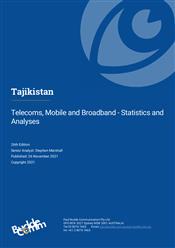
Publication Date: September 2026
Report Pages: 81
Analyst: Sebastien De Rosbo
Tajikistan forges ahead with 5G commercial rollouts while fixed networks languish
The nation of Tajikistan has had to struggle through a further two years of economic hardship following the onset of the Covid-19 pandemic. This has included receiving millions of dollars in foreign aid and loans just to maintain liquidity in a country that is already one of the most impoverished in the region. The strain on financial resources inevitably means a continuation of the absence of any meaningful investment or development programs for telecommunications infrastructure, beyond the occasional symbolic and superficial pronouncements from the government for the sector to ‘do better’.
The fixed-line telephony and fixed broadband markets continue to languish far behind the mobile sector in terms of teledensity and penetration. With only around 6,000 fixed broadband customers (0.07% penetration), there would appear to be massive growth potential but the limited fixed-line infrastructure in the country suggests there’s little likelihood of that occurring any time soon.
The size of Tajikistan’s mobile market dwarfs the fixed-line segment, with an estimated penetration rate of nearly 120%. With a number of private sector companies active in the mobile market, so too has there been more commitment to investment in network upgrades and expansion. Three MNOs – MegaFon, Tcell, and ZET Mobile – have all launched commercial 5G services, initially in areas of the capital city Dushanbe. The move towards higher-speed mobile services should further underpin the growth in the nascent mobile broadband market, which is still estimated to be at a relatively low penetration level of 42% (at least relative to most other Asian nations) but is predicted to enjoy a strong compound annual growth rate of more than 8% for at least the next five years.
This report includes the regulator's latest market data, Telecom Maturity Index charts and analyses, assessment of the global impact of Covid-19 on the telecoms sector, and other recent market developments.
Key developments:
- Three MNOs – MegaFon, Tcell, and ZET Mobile – launch commercial 5G services.
- The government orders the CS to introduce measures to improve the speed and quality of Tajikistan’s internet connections.
- ZET Mobile signs an MoU with Smart City to develop an LTE-based IoT and smart city infrastructure in Dushanbe.
- MegaFon launches the first commercial VoLTE service in Tajikistan.
- Tcell launches a GPON fibre-based fixed broadband service in Dushanbe.
Companies mentioned in this report:
- Tajik Telecom, Babilon Mobile, Tcell, TK Mobile, MegaFon, ZET Mobile.
Related Reports
- 2019 Asia - Mobile Network Operators and MVNOs
- 2019 Asia - Fixed Broadband Market - Statistics and Analyses
- 2019 Asia - Mobile Infrastructure and Mobile Broadband
- Brunei Darussalam - Telecoms, Mobile and Broadband - Statistics and Analyses
- Maldives - Telecoms, Mobile and Broadband - Statistics and Analyses
- Vietnam - Telecoms, Mobile and Broadband - Statistics and Analyses
- Sri Lanka - Telecoms, Mobile and Broadband - Statistics and Analyses
- Mongolia - Telecoms, Mobile and Broadband - Statistics and Analyses
- Nepal - Telecoms, Mobile and Broadband - Statistics and Analyses
- Armenia - Telecoms, Mobile and Broadband - Statistics and Analyses
Share this Report
TMT Intelligence
A platform to scale your intelligence tasks
Monitor critical insights with our AI-powered Market Intelligence Platform gathering and analyzing intelligence in real time. With AI trained to spot emerging trends and detect new strategic opportunities, our clients use TMT Intelligence to accelerate their growth.
If you want to know more about it, please see:
Research Methodology
BuddeComm's strategic business reports contain a combination of both primary and secondary research statistics, analyses written by our senior analysts supported by a network of experts, industry contacts and researchers from around the world as well as our own scenario forecasts.
For more details, please see:
More than 4,000 customers from 140 countries utilise BuddeComm Research
Are you interested in BuddeComm's Custom Research Service?
Hot Topics
News & Views
Have the latest telecommunications industry news delivered to your inbox by subscribing to BuddeComm's weekly newsletter.