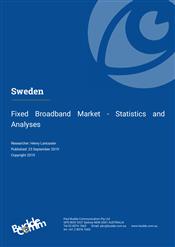
Sweden - Fixed Broadband Market - Statistics and Analyses
Last updated: 23 Sep 2019 Update History
Report Status: Archived
Report Pages: 49
Analyst: Henry Lancaster
Synopsis
Effective government broadband policies during the last few years have helped Sweden develop one of the highest broadband penetration rates in Europe. DSL was overtaken by fibre as the dominant fixed-line platform as early as 2014 and the number of subscribers is falling steadily as customers continue to migrate to fibre networks. There is also competition from HFC infrastructure, with the main cableco Com Hem offering data rates at up to 1Gb/s on its fibre network. It is also investing in services based on the DOCSIS3.1 standard. In mid-2019 Tele2 completed its acquisition of Com Hem, a move which has provided a stronger multi-sector competitor to Telia.
Sweden’s fibre sector is also among the most vibrant in the world, with the country now having one of the highest fibre-broadband densities in Europe. Further development of the fibre sector is key to the government’s revised broadband strategy for 2025, which will see 98% of broadband lines able to access a 1Gb/s service.
Considerable investment in mobile networks has also made mobile broadband a fast-growing sector, with LTE-based services available in most rural areas not covered by fixed-line infrastructure, and with 5G expected to be integral to the overall broadband platform in coming years The development of 5G during the next decade will place downward pressure on fixed broadband growth as some customers (particularly in rural areas) will be minded to move to 5G for data services.
This report examines Sweden’s fixed and fixed-wireless broadband markets, including analyses of market dynamics and the main operators, as well as providing subscriber forecasts.
Key developments:
- Tele2 and Com Hem merger completed;
- Government promotes new broadband strategy to 2025;
- Telia completes G.fast field trials to deliver 1Gb/s services;
- Com Hem launches a 1.2Gb/s fibre service;
- Telia commits to SEK5 billion investment to connect up to one million households with FttP;
- Report update includes the regulator’s market data to December 2018, telcos’ operating and financial data to Q2 2019, recent market developments.
Companies mentioned in this report:
Telia Company, Telenor Sweden, Com Hem, PiteEnergi, BAS
Related Reports
- Sweden - Telecoms, Mobile and Broadband - Statistics and Analyses
- Europe - Mobile Network Operators and MVNOs
- Luxembourg - Telecoms, Mobile and Broadband - Statistics and Analyses
- Montenegro - Telecoms, Mobile and Broadband - Statistics and Analyses
- Denmark - Telecoms, Mobile and Broadband - Statistics and Analyses
- Czech Republic - Telecoms, Mobile and Broadband - Statistics and Analyses
- Greece - Telecoms, Mobile and Broadband - Statistics and Analyses
- Cyprus - Telecoms, Mobile and Broadband - Statistics and Analyses
- Belarus - Telecoms, Mobile and Broadband - Statistics and Analyses
- Austria - Telecoms, Mobile and Broadband - Statistics and Analyses
Share this Report
TMT Intelligence
A platform to scale your intelligence tasks
Monitor critical insights with our AI-powered Market Intelligence Platform gathering and analyzing intelligence in real time. With AI trained to spot emerging trends and detect new strategic opportunities, our clients use TMT Intelligence to accelerate their growth.
If you want to know more about it, please see:
Research Methodology
BuddeComm's strategic business reports contain a combination of both primary and secondary research statistics, analyses written by our senior analysts supported by a network of experts, industry contacts and researchers from around the world as well as our own scenario forecasts.
For more details, please see:
More than 4,000 customers from 140 countries utilise BuddeComm Research
Are you interested in BuddeComm's Custom Research Service?
Hot Topics
News & Views
Have the latest telecommunications industry news delivered to your inbox by subscribing to BuddeComm's weekly newsletter.