Eswatini (Swaziland) Telecoms Market Report
Telecoms, Mobile and Broadband - Statistics and Analyses
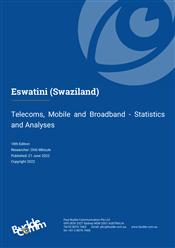
Publication Date: October 2026
Report Pages: 101
Lead Analyst: Henry Lancaster
Contributing Analyst: Peter Lange
Government of Eswatini introduces a National Cybersecurity Strategy
Eswatini (or eSwatini) was one of the last countries in the world to open up its telecom market to competition. Until 2011 the state-owned Eswatini Posts and Telecommunications also acted as the industry regulator and had a stake in the country’s sole mobile network, in an uneasy partnership with MTN Eswatini.
A new independent regulatory authority was established in late 2013 and has since embarked on significant changes to the sector. Eswatini Telecom was provided with a unified licence in early 2016, while MTN Eswatini secured spectrum in the 1800MHz band to provide LTE services. Eswatini Mobile has launched GSM, 3G and LTE services, supported by a network sharing agreement with MTN Eswatini.
Mobile market penetration has been affected by the common use among subscribers of taking SIM cards from different networks in order to access cheaper on-net calls. Subscriber growth has slowed in recent years, but was expected to have reached 8% in 2021, as people adapted to the changing needs for connectivity caused by the pandemic.
The internet sector has been open to competition with a small number of licensed ISPs. Although DSL services were introduced in 2008, development of the sector has been hampered by the limited fixed-line infrastructure and by a lack of competition in the access and backbone networks.
Eswatini is landlocked and so depends on neighbouring countries for international bandwidth. This has meant that access pricing is relatively high, and market penetration remains relatively low. However, prices have fallen recently in line with greater bandwidth availability resulting from several new submarine cable systems which have reached the region in recent years. In addition, Paratus in September 2020 completed a terrestrial cable linking Mozambique with Eswatini and South Africa.
Recognising that increasing digitalisation and access to internet has made more of the country’s population vulnerable to technology-related crimes, the government of Eswatini has implemented its National Cybersecurity Strategy which runs until 2025.
Key developments:
- MTN Eswatini consolidates dominance in the mobile market, expands LTE service reach, reduces the cost of monthly data bundles;
- Government develops National Cybersecurity Strategy running to 2025;
- Regulator imposes sliding scale reduction in call termination rates through to 2023, introduces the Fixed Services Band Plan;
- Paratus completes 750km terrestrial cable linking Maputo through Eswatini to Johannesburg;
- Regulator revokes previous decision to require Eswatini Post and Telecommunications Corporation to divest its ownership in MTN;
- Mbabane Internet Exchange Point (MB-IX) is opened to route local traffic;
- Report update includes operator data to Q1 2022, updated Telecom Maturity Index charts and analyses, regulator’s market report to March 2021, recent market developments.
Companies mentioned in this report:
Eswatini Posts & Telecommunications Corporation (EPTC), MTN Eswatini, Africa Online, Posix, Real Image, Viettel, Eswatini Mobile
Related Reports
- Africa - Mobile Infrastructure and Mobile Broadband
- Africa - Mobile Network Operators and MVNOs
- Africa - Fixed Broadband Market - Statistics and Analyses
- Democratic Republic of Congo - Telecoms, Mobile and Broadband - Statistics and Analyses
- Djibouti - Telecoms, Mobile and Broadband - Statistics and Analyses
- Tunisia - Telecoms, Mobile and Broadband - Statistics and Analyses
- Botswana - Telecoms, Mobile and Broadband - Statistics and Analyses
- Sierra Leone - Telecoms, Mobile and Broadband - Statistics and Analyses
- Mauritania - Telecoms, Mobile and Broadband - Statistics and Analyses
- Niger - Telecoms, Mobile and Broadband - Statistics and Analyses
Share this Report
TMT Intelligence
A platform to scale your intelligence tasks
Monitor critical insights with our AI-powered Market Intelligence Platform gathering and analyzing intelligence in real time. With AI trained to spot emerging trends and detect new strategic opportunities, our clients use TMT Intelligence to accelerate their growth.
If you want to know more about it, please see:
Research Methodology
BuddeComm's strategic business reports contain a combination of both primary and secondary research statistics, analyses written by our senior analysts supported by a network of experts, industry contacts and researchers from around the world as well as our own scenario forecasts.
For more details, please see:
More than 4,000 customers from 140 countries utilise BuddeComm Research
Are you interested in BuddeComm's Custom Research Service?
Hot Topics
News & Views
Have the latest telecommunications industry news delivered to your inbox by subscribing to BuddeComm's weekly newsletter.