South Africa - Telecoms Infrastructure, Operators, Regulations - Statistics and Analyses
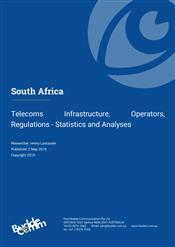
Last updated: 2 May 2019 Update History
Report Status: Archived
Report Pages: 70
Analyst: Henry Lancaster
Synopsis
South Africa’s telecom sector boasts one of the most advanced infrastructures on the continent. There is has been considerable investment from Telkom, Liquid Telecom South Africa, Broadband InfraCo and municipal providers as well as from mobile network operators all aimed at improving network capabilities. The focus in recent years has been on backhaul capacity and on fibre and LTE networks to extend and improve internet service connectivity.
The poor historic availability and level of service of fixed-line networks encouraged the growth of the mobile sector for both voice and data services and this segment continues to command most investment and effort among telcos. Under a converged regulatory regime many alternative service providers have been able to enter the market to offer a range of services. Proposed amendments to the Communications Act are intended to improve the ability of new entrants to access networks and further develop a competitive market landscape.
The end of Telkom’s monopoly on international submarine fibre optic cables also reduced the cost of telecom services dramatically. New cables are extending connectivity to India, Brazil and onto the USA, which will further increase international bandwidth and so improve services generally.
Other key regulatory matters aimed at shaping the market include the licensing of LTE spectrum in several bands. A multi-spectrum auction, delayed since late 2016 and which has caused some difficulties for mobile network operators desperately short of spectrum and which have had to rely on spectrum refarming and other measures to increase network capacity, is scheduled for mid-2019.
To develop competition the government created Broadband InfraCo, a national infrastructure company to provide cheap backbone network capacity to service providers. Since late 2017 the government has promoted a scheme to merge Broadband Infraco with Sentech's satellite service to create a national broadband network managed by a single broadband provider.
The major mobile network operators, Vodacom, MTN and Cell C, have also moved into the fixed-line and national fibre sector under a converged, service-neutral licensing regime. In addition, many municipalities in South Africa are implementing their own metropolitan fibre and wireless broadband networks, while several Fibre-to-the-Premises (FttP) deployments are underway.
Key developments:
- South Africa to deploy nanosatellites;
- Microsoft to build two data centres during 2019;
- Regulator and USAASA seek to raise ZAR100 billion for ICT projects by increasing USAF levy to 1% of operator revenue;
- Telkom reports strong revenue growth in fiscal H1 2019, continues work on the Modderfontein Smart City development;
- Vodacom contracts Alcatel-Lucent to build a GPON FttP converged network;
- Report update includes the regulator's the regulator's March 2019 report on the ICT sector, Telecom maturity Index charts and analyses, operator data to December 2018.
Companies mentioned in this report:
Telkom, Liquid Telecom South Africa (Neotel), Vodacom, MTN, Cell C, Virgin Mobile, Broadband InfraCo, Transtel, Eskom, SEACOM, Telkom, Neotel (Tata), Vodacom, MTN, Broadband InfraCo, Transtel, Eskom, SITA, Sentech, SEACOM, Dark Fibre Africa (DFA), Internet Solutions, FibreCo, eFive, WASACE.
Related Reports
- Africa - Fixed Broadband Market - Statistics and Analyses
- South Africa - Telecoms, Mobile and Broadband - Statistics and Analyses
- 2019 Africa - Mobile Network Operators and MVNOs
- Ethiopia - Telecoms, Mobile and Broadband - Statistics and Analyses
- Morocco - Telecoms, Mobile and Broadband - Statistics and Analyses
- Namibia - Telecoms, Mobile and Broadband - Statistics and Analyses
- Madagascar - Telecoms, Mobile and Broadband - Statistics and Analyses
- Benin - Telecoms, Mobile and Broadband - Statistics and Analyses
- Cameroon - Telecoms, Mobile and Broadband - Statistics and Analyses
- Eritrea - Telecoms, Mobile and Broadband - Statistics and Analyses
Share this Report
TMT Intelligence
A platform to scale your intelligence tasks
Monitor critical insights with our AI-powered Market Intelligence Platform gathering and analyzing intelligence in real time. With AI trained to spot emerging trends and detect new strategic opportunities, our clients use TMT Intelligence to accelerate their growth.
If you want to know more about it, please see:
Research Methodology
BuddeComm's strategic business reports contain a combination of both primary and secondary research statistics, analyses written by our senior analysts supported by a network of experts, industry contacts and researchers from around the world as well as our own scenario forecasts.
For more details, please see:
More than 4,000 customers from 140 countries utilise BuddeComm Research
Are you interested in BuddeComm's Custom Research Service?
Hot Topics
News & Views
Have the latest telecommunications industry news delivered to your inbox by subscribing to BuddeComm's weekly newsletter.