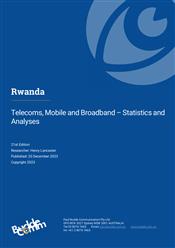
Rwanda Telecoms Market Report
Telecoms, Mobile and Broadband - Statistics and Analyses
Last updated: 22 Jun 2026 Update History
Report Status: Current
Report Pages: 193
Analyst: Henry Lancaster
Rwanda aims for an ambitious digital transformation
In recent years, Rwanda has taken several steps to develop economic growth through the greater use of telecoms and ICT. To this end, it has encouraged upgrades to the national telecom network and the extension of terrestrial fibre links through neighbouring countries for access to several subsea cable systems. Having historically relied on cable connectivity on the Indian Ocean coast, the country is now part of the East-to-West Coast African corridor, following a route running between Mombasa on the Indian Ocean and Muanda on the Atlantic Ocean.
These connections enabled Rwanda’s telcos and ISPs to almost double international bandwidth in 2025. In turn, this is supporting the government’s long-term ambitions to transform the economy with digital tools, encourage the use of digital services, and ensure that all government services are entirely online by 2030. With further investment in data centres, Rwanda is also aiming to become a regional hub for data hosting.
The mobile sector is a duopoly of MTN Rwanda and Airtel Rwanda. MTN Rwanda remains the dominant operator, holding 66% of the market by subscribers. The company’s strategy has been to secure revenue growth by focusing on the high-end business segment. It has invested in LTE network expansion and was the first MNO to launch 5G services, though thus far 5G is limited to areas of Kigali. Airtel Rwanda has adopted a different strategy, being focused on affordability in an attempt to encourage churn from MTN’s customer base. Airtel is involved in the government’s ConnectRwanda 2.0 initiative, aimed at bridging the digital divide. Airtel’s contribution has focused on importing and distributing over a million low-cost LTE smartphones and providing flexible payment plans.
The fixed broadband sector has suffered from limited fixed-line infrastructure and high prices. Although satellite services are too expensive for most people, and thus are largely limited to the business sector, there have been important developments. Paratus Rwanda became a local distributor of Starlink’s broadband services, while the government earlier in 2026 signed up to an initiative to deploy a regional satellite to enhance connectivity across East Africa’s northern corridor.
Key developments:
- MTN Rwanda extends 5G services to more areas of Kigali.
- Rwanda joins the Northern Corridor Regional Communication and Broadcasting Satellite Initiative (NCRCBSI), aimed at deploying a jointly owned regional satellite.
- Rwanda targets $5 billion in investment in a new data hub.
- Paratus Rwanda sets up as a distributor for Starlink’s satellite broadband services and opens a new fibre route.
- MTN Rwanda’s LTE population coverage reaches 94.8%.
- Report update includes the regulator’s annual reports, market data to December 2025, telcos’ operating data to Q4 2025, updated Telecom Maturity Index tables, charts and analyses, recent market developments.
Companies mentioned in this report:
Rwandatel (Terracom, LapGreen), MTN Rwanda (MTN Rwandacell), Liquid Telecom (LIT), Tigo Rwanda (Millicom), Bharti Airtel, Artel Rwanda, Electrogaz
Related Reports
- Africa - Fixed Broadband Market - Statistics and Analyses
- Africa - Mobile Infrastructure and Mobile Broadband
- Africa - Mobile Network Operators and MVNOs
- South Africa - Telecoms, Mobile and Broadband - Statistics and Analyses
- South Sudan - Telecoms, Mobile and Broadband - Statistics and Analyses
- Sudan - Telecoms, Mobile and Broadband - Statistics and Analyses
- Mauritius - Telecoms, Mobile and Broadband - Statistics and Analyses
- Egypt - Telecoms, Mobile and Broadband - Statistics and Analyses
- Guinea - Telecoms, Mobile and Broadband - Statistics and Analyses
- Ethiopia - Telecoms, Mobile and Broadband - Statistics and Analyses
Share this Report
TMT Intelligence
A platform to scale your intelligence tasks
Monitor critical insights with our AI-powered Market Intelligence Platform gathering and analyzing intelligence in real time. With AI trained to spot emerging trends and detect new strategic opportunities, our clients use TMT Intelligence to accelerate their growth.
If you want to know more about it, please see:
Research Methodology
BuddeComm's strategic business reports contain a combination of both primary and secondary research statistics, analyses written by our senior analysts supported by a network of experts, industry contacts and researchers from around the world as well as our own scenario forecasts.
For more details, please see:
More than 4,000 customers from 140 countries utilise BuddeComm Research
Are you interested in BuddeComm's Custom Research Service?
Hot Topics
News & Views
Have the latest telecommunications industry news delivered to your inbox by subscribing to BuddeComm's weekly newsletter.