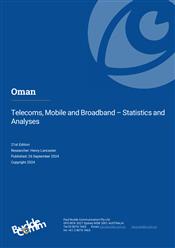
Oman Telecoms Market Report
Telecoms, Mobile and Broadband - Statistics and Analyses
Oman preps for closing down 3G networks
Oman has made considerable progress in migrating mobile infrastructure from legacy networks to LTE and 5G. The regulator is managing a program to close down 3G infrastructure, a process largely complete by late 2024 and which will allow the MNOs to refarm spectrum for 5G. Progress with developing 5G has been steady, with the number of sites doubling in 2023 alone, and having increased 19% in the year to June 2024. Of the sites installed by then, about a third were in Muscat.
The mobile market had long been a duopoly between the incumbent telco Omantel and its challenger Ooredoo Oman. In January 2022, Vodafone Oman launched commercial services and immediately impacted on the market share and revenue of the two main players.
Oman’s fixed broadband infrastructure penetration is considered low, at about 11% in early 2024, though the regulator has encouraged the building out of fibre-based networks as part of Oman’s Vision 2040 program. It is expected that at least three-quarters of all buildings in the Sultanate will be fibre-enabled by 2025.
Oman has also established itself as an important communications hub in the Middle East, with access to numerous submarine cables including the 2Africa submarine cable, which should become available by late 2024. There is also the new 275km Oman Emirates Gateway (OEG) cable link connecting data centres in the UAE and Oman, while in mid-2024 work started on a network connecting Pakistan with the UAE and Oman.
Key developments:
- Ooredoo Financial Technology International (OFTI) secures a Payment Service Provider license in Oman.
- Fixed broadband provider Awasr opens the Oman-IX IXP.
- Oman nears completion of a project to shut down 3G networks and refarm spectrum for LTE and 5G.
- Starlink Muscat is issued a Class I licence to provide satellite broadband services in the Sultanate.
- Report update includes operator data to Q2 2024, regulator’s market data to June 2024, updated Telecom Maturity Index analyses and charts, recent market developments.
Companies mentioned in this report include:
Oman Telecommunications Company (Omantel), Oman Mobile, Ooredoo Oman, Oman Broadband Company (OBC), FRiENDi, Majan Telecom (Renna), Integrated Telecommunications Oman (TeO), Awasr-Oman, Oman Future Telecommunications (OFT) consortium, Vodafone Group, Oman Tower Company (OTC)
Related Reports
- ME Telecom Country Bundle Reports (2022-2023 edition)
- Middle East - Mobile Network Operators and MVNOs
- Middle East - Mobile Infrastructure and Mobile Broadband
- Middle East - Fixed Broadband Market (Bundle 11 reports 2022-2023)
- Bahrain - Telecoms, Mobile and Broadband - Statistics and Analyses
- Qatar - Telecoms, Mobile and Broadband - Statistics and Analyses
- Israel - Telecoms, Mobile and Broadband - Statistics and Analyses
- Turkey - Telecoms, Mobile and Broadband - Statistics and Analyses
- Iraq - Telecoms, Mobile and Broadband - Statistics and Analyses
- Iran - Telecoms, Mobile and Broadband - Statistics and Analyses
Share this Report
TMT Intelligence
A platform to scale your intelligence tasks
Monitor critical insights with our AI-powered Market Intelligence Platform gathering and analyzing intelligence in real time. With AI trained to spot emerging trends and detect new strategic opportunities, our clients use TMT Intelligence to accelerate their growth.
If you want to know more about it, please see:
Research Methodology
BuddeComm's strategic business reports contain a combination of both primary and secondary research statistics, analyses written by our senior analysts supported by a network of experts, industry contacts and researchers from around the world as well as our own scenario forecasts.
For more details, please see:
More than 4,000 customers from 140 countries utilise BuddeComm Research
Are you interested in BuddeComm's Custom Research Service?
Hot Topics
News & Views
Have the latest telecommunications industry news delivered to your inbox by subscribing to BuddeComm's weekly newsletter.