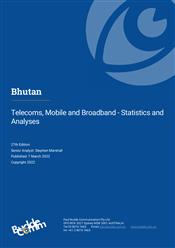
Bhutan Telecoms Market Report
Telecoms, Mobile and Broadband - Statistics and Analyses
Publication Date: June 2026
Report Pages: 90
Analyst: Sebastien De Rosbo
Bhutan telecom market liberalisation and modernisation to drive new growth from 2022
The small land-locked Kingdom of Bhutan has only recently emerged from decades of isolation from the modern world. That, and its mountainous terrain, left the country far back in the field in terms of teledensity as well as access to the Internet.
Over the last decade, however, the country has undergone a significant transformation due to the opening of its borders, liberalisation of its telecom sector, and the active support from the government towards increased competition in the mobile, broadband, and ISP segments.
A lack of investment in fixed-line infrastructure over the years by the national (state-owned) telco Bhutan Telecom means that fixed-line telephony and fixed broadband penetration will forever stay low (estimated to be 3.0% and 0.4%, respectively, in 2021). But the relatively widespread availability of the mobile platform has caused an explosion in mobile broadband subscriber numbers, growing from zero to over 100% penetration in just ten years (between 2010 and 2019). The onset of the Covid-19 crisis in 2020 caused the subscription rate to drop back a little – even though Bhutan has successfully managed to keep its case numbers and mortality very low. Growth is projected to return in 2022 (along with the broader mobile market) as the overall economy recovers; the government opens up more to foreign investment, trade, and tourism; and network expansion continues – the recent (December 2021) launch of 5G services by both of the country’s mobile operators being particularly noteworthy.
This report includes the regulator's market data to September 2021, telcos' financial and operating data updates to September 2021, Telecom Maturity Index charts and analyses, assessment of the global impact of Covid-19 on the telecoms sector, and other recent market developments.
Key developments:
- B-Mobile and Tashi Cell launch 5G services for a selected range of handsets.
- Tashi Cell reaches parity in mobile market share with the incumbent provider B-Mobile.
- Bank of Bhutan launches two mobile-based digital banking platforms: eLoan and goBoB.
Companies mentioned in this report
Bhutan Telecom, Tashi InfoComm, B-Mobile, Tashi Cell, DrukNet.
Related Reports
- 2019 Asia - Mobile Network Operators and MVNOs
- 2019 Asia - Fixed Broadband Market - Statistics and Analyses
- 2019 Asia - Mobile Infrastructure and Mobile Broadband
- India - Telecoms, Mobile and Broadband - Statistics and Analyses
- Turkmenistan - Telecoms, Mobile and Broadband - Statistics and Analyses
- Indonesia - Telecoms, Mobile and Broadband - Statistics and Analyses
- Malaysia - Telecoms, Mobile and Broadband - Statistics and Analyses
- Georgia - Telecoms, Mobile and Broadband - Statistics and Analyses
- Hong Kong - Telecoms, Mobile and Broadband - Statistics and Analyses
- Pakistan - Telecoms, Mobile and Broadband - Statistics and Analyses
Share this Report
TMT Intelligence
A platform to scale your intelligence tasks
Monitor critical insights with our AI-powered Market Intelligence Platform gathering and analyzing intelligence in real time. With AI trained to spot emerging trends and detect new strategic opportunities, our clients use TMT Intelligence to accelerate their growth.
If you want to know more about it, please see:
Research Methodology
BuddeComm's strategic business reports contain a combination of both primary and secondary research statistics, analyses written by our senior analysts supported by a network of experts, industry contacts and researchers from around the world as well as our own scenario forecasts.
For more details, please see:
More than 4,000 customers from 140 countries utilise BuddeComm Research
Are you interested in BuddeComm's Custom Research Service?
Hot Topics
News & Views
Have the latest telecommunications industry news delivered to your inbox by subscribing to BuddeComm's weekly newsletter.